


Parents can find resources to help their children stay well in this section.
Safeguarding means: protecting children from abuse and maltreatment, preventing harm to children's health or development, ensuring children grow up with the provision of safe and effective care.
Safeguarding is the responsibility of everyone involved in the care of a young person and in this section parents will find resources to help them to play their part in this.
New material is added regularly to this page so please keep coming back to see what's new.
Family support and Early Help
Help at Tupton Hall School
At Tupton Hall School, we are committed to supporting the wellbeing, safety and success of all students and their families. Early Help forms an important part of our pastoral and safeguarding structure, enabling us to identify and respond to emerging needs before they become more significant concerns.
We recognise that young people may face challenges that can affect their learning, attendance, behaviour, emotional wellbeing or personal development. Through a coordinated and supportive approach, we work closely with students, families and external agencies to provide the right support at the right time.
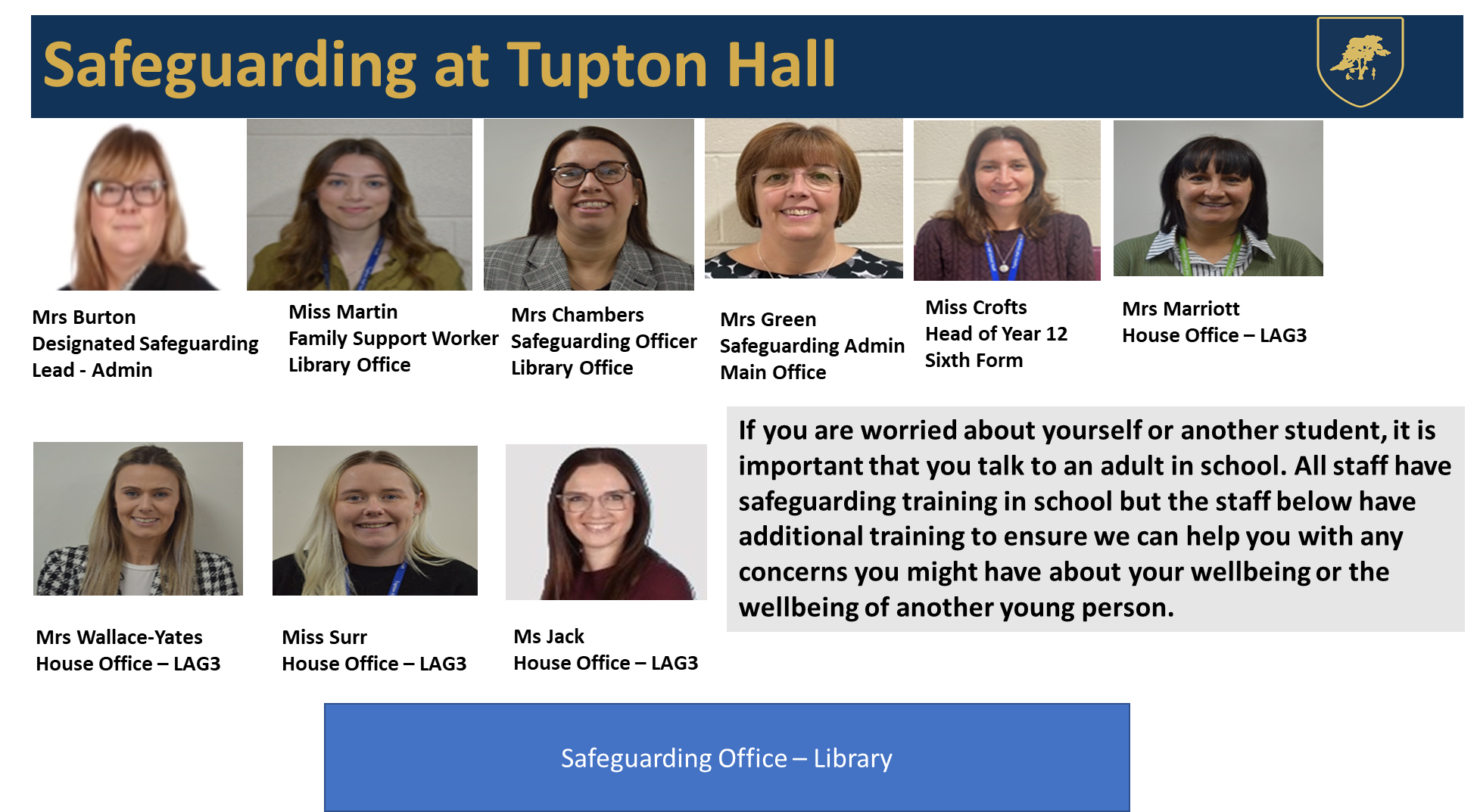
Our pastoral and wellbeing support is delivered through a dedicated team that includes our Family Support Worker, who coordinates Early Help Assessments and works closely with families to identify needs and access appropriate support. Students are also supported by our DSL, Senior Leadership Team, Safeguarding Officer, House Support Officers, Attendance Officers, Student Services and Heads of House, who provide guidance, pastoral care and practical support throughout their school journey.
In addition, the school offers a wide range of targeted interventions designed to support students with common adolescent challenges, including emotional wellbeing, mental health, attendance, behaviour, social skills, self-esteem, friendship issues and resilience. Where appropriate, we work collaboratively with external agencies and specialist services to ensure students and families receive the support they need.
Through our Early Help offer, we aim to remove barriers to learning, promote positive outcomes and help every student thrive both academically and personally, leaving Tupton achieving their full potential.
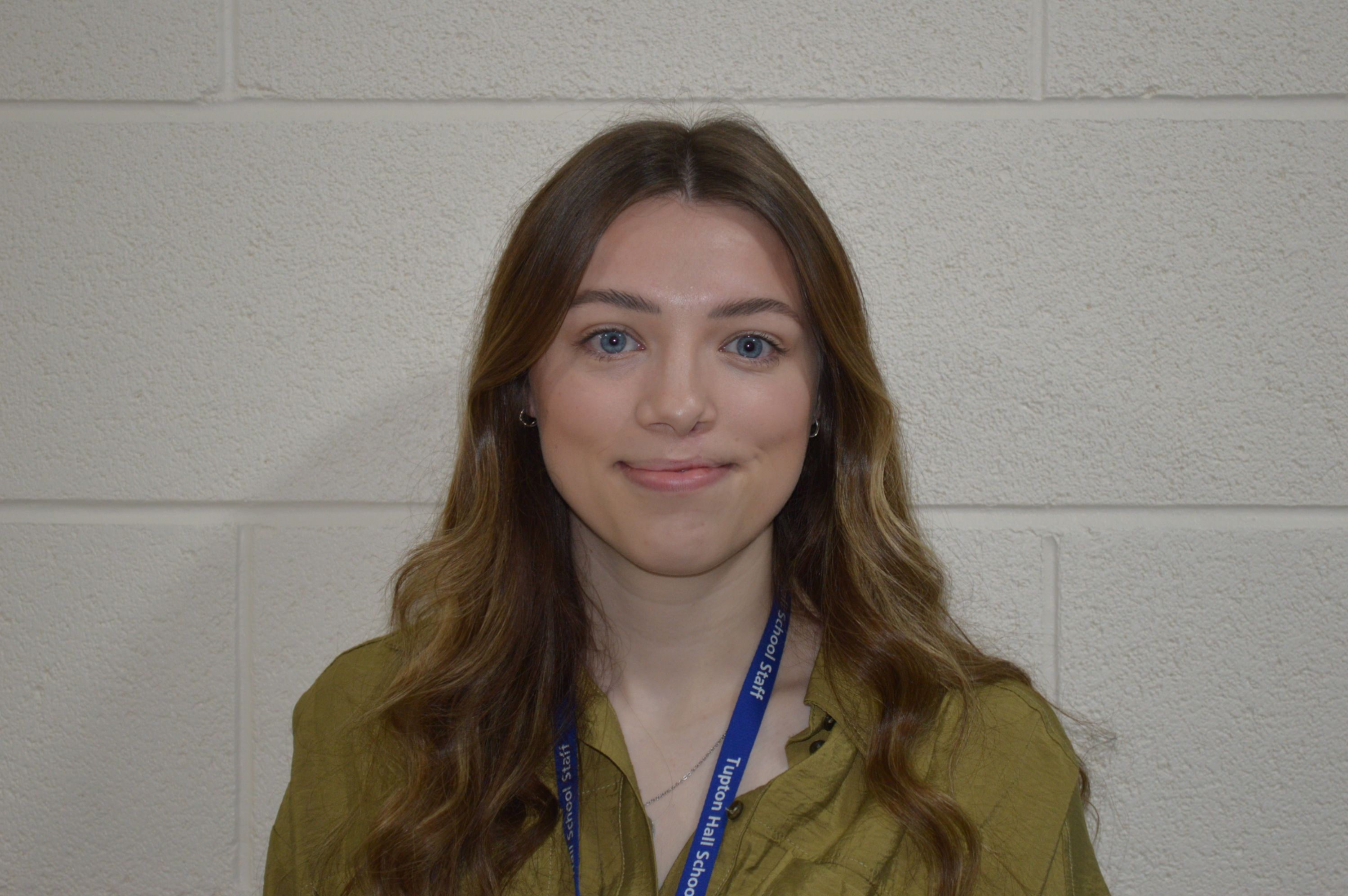
Miss Z Martin
Pastoral & Family Support Worker
The assessment considers a range of factors, including:
- The views, wishes and feelings of the young person.
- Any concerns, vulnerabilities or risks that may be affecting their wellbeing, development or safety.
- The impact of family, peer, community, school or online influences.
- Significant life events, experiences or trauma that may be affecting the young person.
- The likely outcomes if identified concerns are not addressed.
- The understanding and engagement of parents/carers.
- The strengths, protective factors within the family.
- Previous support, interventions and their effectiveness.
- Current support available through school and other services.
- Whether additional support from external agencies is required.
- What is working well, what challenges remain, and what actions are needed to achieve positive outcomes.
Early Help Assessments
An Early Help Assessment (EHA) is a voluntary tool used to identify and respond to emerging needs for young people and their families. It provides a structured framework for understanding a family's strengths, identifying areas where support maybe needed, and coordinating appropriate interventions through partnership working with
At our school, Early Help Assessments are coordinated by our Family Support Worker, who works closely with students, families, pastoral staff and external professionals to ensure that support is provided at the earliest opportunity. The aim is to prevent concerns from escalating and to improve outcomes for young people and their
When considering the need for Early Help, the school follows the Derbyshire Thresholds Document alongside the school's Graduated Response document. These frameworks help staff to identify levels of need, determine the most appropriate course of action, and ensure that support is proportionate, timely and effective.
As part of the assessment process, information is gathered from a range of sources to develop a clear understanding of the young person's circumstances. This process may take several weeks depending on the complexity of the situation and the involvement of other agencies.
The Early Help process is centred on partnership working, ensuring that children, young people and families are fully involved in decision-making and that support is tailored to their individual needs. Through collaboration between school, home and external agencies, we aim to provide the right support at the right time to promote wellbeing, resilience and successful outcomes.
Operation Encompass
Operation Encompass is a police and school early intervention safeguarding information sharing partnership which supports children experiencing domestic violence and abuse.
Operation Encompass is based upon the national requirements to not only identify children in need of support but to also ensure that this support is put in place immediately.
‘Nothing is more important than children’s welfare. Children who need help and protection deserve high quality and effective support as soon as a need is identified.’
Police are a ‘local safeguarding partner’ required to ‘make arrangements to work together’ (with the other partners) ‘to safeguard and promote the welfare of local children including identifying and responding to their needs’.
Working Together to Safeguard Children and all its requirements apply to all schools.
- Adolescent to Parent Violence and Abuse (opens in new tab)
- Operation Encompass Pathways (opens in new tab)
Reporting Abuse
CEOP
CEOP tries to keep children safe from sexual abuse and grooming online. They are unable to respond to reports about bullying, fake accounts or account hacking.
You can make a report directly to CEOP if something has happened online which has made a child feel unsafe, scared or worried. This might be from someone they know in real life, or someone they have only ever met online. CEOP take all reports seriously and will do everything they can to keep the young person safe.
As well as making a report, the CEOP Education website has information and advice to help if something has happened to a young person online.
Follow this link for further information on the kinds of things that can be reported to CEOP:
https://www.ceop.police.uk/Safety-Centre/Should-I-make-a-report-to-CEOP-YP/

Reporting Inappropriate Images or Videos of Children Online
Anonymously report suspected child sexual abuse images or videos
We know that seeing images and videos of child sexual abuse online is upsetting. But if you stumble across it, report it to us.
Reporting is quick, easy and anonymous. It can lead to the removal of criminal content and even the rescue of a child from further abuse. If you’d like to find out what happens with your report, you can leave an email address and request we get in touch.
You can confidentially report:
- Child sexual abuse pictures or videos on the internet.
- AI, animation, cartoon or 'drawn' child sexual abuse images.
- The first column.

Policies
Please click here to view our policies page, where you will be able to find our anti-bullying policy, Keeping Children Safe in Education, Child Protection and Safeguarding Policy, ESafety Policy, and SENDco Policy amongst others.
Medicines in School
Please complete the following form and return them to school, either by post or via email to: enquiries@tuptonhall.org.uk
Special Educational Needs & Disabilities
Tupton Hall School is a fully inclusive mainstream school where every student is valued regardless of their ability, needs or interests. Our objective is to improve the educational outcomes of students with additional needs, thereby ensuring no child is left behind.
Tupton Hall School is committed to:
- Providing timely and effective support to meet individual children's need.
- Ensuring that all children have the right support to ensure they achieve their potential.
- Supporting children's social, emotional wellbeing and mental health.
- Removing barriers to learning.
At Tupton Hall, the Inclusion Team works closely with staff across the school to support students with special educational needs and disabilities (SEND), ensuring that they are fully integrated into the life of the school whilst developing their self-esteem, confidence and independence.
If you require any additional information please contact the SENDCO, Mrs Barnett, on 01246 863127 or email at a.barnett@tuptonhall.org.uk.
Our SEN Information Report
As a school, we are mindful of and comply with the expectations of the SEN and Disability Code of Practice 0-25 years, introduced by the Government in June 2014. We also adhere to the Equality Act 2010.
We use different interventions and approaches to address specific areas of need and would look carefully at your child’s individual needs when deciding how best to support your child in consultation with parents/carers and the young person.
We have developed a SEN Information Report which explains how we support children with Special Educational Needs in our school.
MORE INFORMATION
- Find out what support is available for young people with Special Educational Needs in Derbyshire through the Derbyshire Local Offer
- Read more about the Department for Education's new code of practice for Special Educational Needs and Disability (SEND) for 0 - 25 year olds: SEND Code of Practice 0 - 25 Years
Keeping Children Safe
Stop, Breathe, Think
Please note a FREE, remote (phone or online video) charity-funded counselling service called 'Stop Breathe Think.' The service offers counselling to all 8 - 21-year-olds and aims to respond to all referrals within 24hrs, with no waiting lists.
- Students can self-refer in here:
- www.stopbreathethink.org.uk/young-person
- Parents can refer their children in here:
- www.stopbreathethink.org.uk/parent
Click here to visit our Lifeskills & Wellbeing page which has resources and parent guides
E-Safety in School
At Tupton Hall, we work to provide high-quality guidance for students and their families about the dangers of the online digital world. We also offer advice and support to help stay safe and avoid these risks and threats.
As part of the Computing and Life Skills and Well-being (PSHE) areas of the curriculum, students in Key Stage 3 learn about what information should not be shared in the public domain. Students also learn Internet etiquette, guidelines they should adhere to on social networking sites, the dangers associated with Internet browsing and the consequences of inappropriate behaviour online.
Click here to visit our Life skills & Well-being page which has resources and parent guides discussing the digital world.
Please also find our Acceptable Use Policy here.