
Curriculum
We place emphasis on good teaching in a broad and balanced curriculum, underpinned by an effective approach to the social, moral, spiritual and cultural development of children and young people, to help to prepare them for life in modern Britain.
If you require more information about any aspect of our curriculum, please contact the relevant faculty leader.
Curriculum Vision
We define the curriculum as everything which happens in school and are committed to building character, resilience and creativity and developing RESPECT, ensuring that reading sits at its heart; everything which is taught and learned by the young people who attend our school.
In that sense, it is not just about the knowledge and skills delivered in lessons but also the vast array of opportunities and experiences we offer to our students outside the classroom through the curriculum plus programme: participation in co-curricular provision, going on school trips and visits, participating in Sport, performing in plays and musicals, taking on specific leadership, volunteering and membership roles, and other types of involvement in the broader life of the school and the community which it serves.
All curriculum subjects along with the vertical tutoring system, share the responsibility of developing students as learners ensuring literacy, oracy and numeracy skills are developed in line with expectations, and preparing them for the world of work and/or further training.
This ethos is reflected in our five core values:
-
High expectations of all students
-
Valuing and celebrating academic achievement
-
Outstanding teaching for all students
-
Widening student experiences
-
Equality and diversity
We understand that building a successful and ambitious curriculum begins the moment our students walk through our doors in Year 7. From the very start of their journey, we support them in becoming confident and knowledgeable subject specialists, equipped with the skills and understanding they need to thrive.
We believe that knowledge is empowering and without limits; it is the passport that opens doors to opportunities long after students leave school. Through our curriculum, we ensure that students develop a rich and ambitious vocabulary, enabling them to access the wider world and communicate effectively in a range of contexts.
We encourage our students to think critically, make informed decisions and express their ideas with confidence, respect and clarity. Above all, we strive to nurture a genuine curiosity and love of learning, ensuring that the knowledge, skills and habits they develop continue to grow throughout their school years and remain with them for life.
We place emphasis on strong teaching in a broad and balanced curriculum, underpinned by an effective approach to the social, moral, spiritual and cultural development of children and young people, to help to prepare them for life in modern Britain. Our curriculum subjects along with our strong pastoral system share the responsibility of developing students as active learners and preparing them for their post 16 life.
Curriculum Aim
We aim to nurture students who:
-
Enjoy learning, make strong progress and achieve excellence
-
Are confident readers; both for pleasure and to deepen their subject specific thirst for knowledge
-
Are responsible citizens who can make a positive contribution to society
Our Curriculum Statement
We define the curriculum as everything which happens in school and are committed to building character, resilience and creativity and developing RESPECT, ensuring that reading sits at its heart; everything which is taught and learned by the young people who attend our school. In that sense, it is not just about the knowledge and skills delivered in lessons but also the vast array of opportunities and experiences we offer to our students outside the classroom through the curriculum plus programme: participation in co-curricular provision, going on school trips and visits, participating in Sport, performing in plays and musicals, taking on specific leadership, volunteering and membership roles, and other types of involvement in the broader life of the school and the community which it serves.
All curriculum subjects along with the vertical tutoring system, share the responsibility of developing students as learners ensuring literacy/oracy and numeracy skills are developed in line with expectations, and preparing them for the world of work and/or further training.
Our Curriculum is built on the 3 tiers of Respect, Knowledge and Enrichment ensuring that reading sits at its heart. We place emphasis on good teaching in a broad and balanced curriculum, underpinned by an effective approach to the social, moral, spiritual and cultural development of children and young people, to help to prepare them for life in modern Britain.
Our teaching and learning priorities predominantly focus upon the development of reading, writing, and speaking skills for all students, delivered through quality first teaching, supported a targeted programme of CPD. In support of this, all teachers are expected to uphold the Tupton Hall Professional Practice and Learning Fundamentals, which ensures key elements of quality first teaching are utilised, in all lessons. In addition, the Tupton Hall Professional Practice and Learning Fundamentals puts the EEF 5-a-day approach at the heart of our day-to-day practice, enabling teachers develop a “repertoire of strategies which they can use daily and flexibly in response to individual needs” (EEF 2021), benefitting all students, not just those with SEN.
Our aim is to provide a wide reading culture for all students, ensuring that our school is a place where reading is valued, promoted and actively encouraged. A core reading curriculum is provided for all KS3 students via the DEAR Time and Accelerated Reading programmes, with bespoke support provided for those students who are not yet able to read at their chronological age. At KS4 and KS5 students are supported to develop their subject specific reading abilities, deepening their knowledge and understanding of the subjects being studied.
All students are supported to develop their oracy skills, via targeted curriculum programmes, high quality teacher questioning or the use of modelled language. All such approaches are threaded throughout the curriculum and span all year groups.
Written communication is highly supported and developed in all curriculum areas. All students are challenged to read, speak and write to the highest ability possible. Through effective teacher support, modelled responses and regular personlised feedback, students are supported to grow and develop their written responses to key learning material and formally assessment pieces.
The Curriculum for Years 7, 8 and 9 allows students to experience a range of subjects and to prepare for their GCSEs as well as develop key learning skills, experience a full range of subjects and co-curricular opportunities to develop character. As GCSE subjects have become more challenging for students, Year 9 has been developed into a “transitional year”, meaning students continue to develop their key learning skills through topic based learning but also start their GCSE subjects. We have developed a “Period 6” slot after the school day which will allow for a range of additional co-curricular activities and for additional work/revision, after the end of the traditional school day.
Teaching is organised around half year groups, most subjects are taught in mixed ability groups in Years 7 and 8; in Maths and English there is setting from Year 7, PE and DT operate a broad banding arrangement.
In Years 9, 10 and 11 there is a wide variety of GCSE subjects available.
Over the last three years the school has encouraged the majority of students to follow an EBacc curriculum route. Year 8 students who are achieving well in Modern Foreign Languages are expected to continue with a language at GSCE. We offer French, German and Spanish at GCSE. All students are expected to choose either History or Geography and one further choice from a wide variety of practical, technical and ‘new start’ subjects. There are plans to increase the number of vocational qualifications as part of our wider curricular offer.
For a very small number of students there bespoke curriculum pathways.
Our RESPECT agenda is at the core of our curriculum - all students follow a PSHE (Life skills and Wellbeing) programme that focuses on personal, social and emotional education, religious education and preparation for life beyond school. We are committed to ensuring students build cultural capital through this programme and embrace diversity, equity, and inclusion with specific focus on the progress of, and curriculum accessibility for, disadvantaged and SEND students. Life Skills and Wellbeing (PSHE) Education is taught across school through a variety of ways by all our teaching staff, such as dedicated lessons, assemblies, specific themed weeks and Impact Days. Our curriculum aims to provide students with;
- A sound understanding of their role as a citizen for now and in the future,
- Promote the representation and participation of different groups of individuals,
- The opportunity to consider wider societal and personal issues and
- The ability to develop critical thinking to make safe and informed decisions.
In line with the Government’s Personal, Social, Health and Economic (PSHE) Education Guidance, Tupton Hall has committed to developing students’ awareness in 3 key areas, including;
- Health & Wellbeing
- Relationships and Sexual Health Education
- The Wider World, Careers and British Values
Underpinning all this, we encourage students to take part in student voice, trips, workshops, fundraising and activities to support the schools 'Respect' agenda.
In Years 12 and 13, we offer a very wide range of A Level subjects, Maths and English resit clinics and a variety of curriculum enrichment activities such as Community Sports Leadership Award, Higher Sports Leadership Award and the Finance Certificate qualifications. There are also a huge number of additional enrichment activities extra to the curriculum such as buddy reading, in lesson support, work experience and mentoring opportunities that sixth form students can become involved in.
Our sixth form curriculum is revised every year to ensure that it meets the needs of students. In recent years several subjects have been added to the offer, including: Modern Foreign Languages, Ethics & Philosophy, Computer Science, Environmental Science, Extended Project Qualification, Core Maths, Financial Studies and Photography.
We also offer students the option to re-sit both English and Maths at GCSE, if they have not yet achieved a Grade 4. This option includes a November and Summer exam entry and the opportunity to attend either timetabled lessons, lower school lessons or study via the curriculum enhancement model
There is ongoing evaluation of curriculum structures by the Senior Leadership Team and Governors.
Curriculum Organisation
Students at Tupton Hall School study for 25 hours per week. This is comprised of 5 one hour lessons each day. The timetable spans two weeks totalling a 50-hour cycle.
Co-Curricular at Tupton Hall School
Our school's Co-Curricular programme is designed to build character, broaden experiences and develop the whole child beyond the classroom. Through a wide range of Curriculum Plus activities, students are encouraged to explore their interests, develop new skills and contribute positively to the school community.
Curriculum Plus activities take place at break and lunchtime, after school and through special events throughout the year. They are open to all students and provide a wealth of opportunities across sport, the expressive arts, design technology, science, modern foreign languages and leadership.
A student's Curriculum Plus experience may include:
-
School trips, visits and residential experiences
-
Performing Arts productions and events
-
Participation in school sports teams
-
The Trust Game events
-
Break, Lunchtime and after-school clubs
-
Duke of Edinburgh's Award
-
Charity and community events
-
House leadership opportunities
-
Inter-house competitions
-
Assemblies, remembrance events and wider personal development activities
-
Careers guidance and work experience opportunities
Post-16 Curriculum (Key Stage 5)
Our Post-16 curriculum is ambitious, inclusive and designed to prepare students successfully for their next steps in education, employment and adult life.
Students can choose from a wide range of Level 3 qualifications. The breadth of the curriculum allows students to construct programmes of study which reflect their strengths, interests and intended destinations. Our offer is reviewed annually in response to student need, recruitment patterns, progression routes and the changing educational and employment landscape. Recent developments have included subjects such as Modern Foreign Languages, Computer Science, Photography and Mental Health: Individuals and Society alongside the Extended Project Qualification (EPQ).
The taught curriculum is complemented by a wider Post-16 programme designed to develop confident, independent and well-rounded young adults. Through our Stellar programme , students are encouraged to contribute to the wider school community and develop skills beyond their academic qualifications. Opportunities include mentoring younger students, buddy reading, work experience, leadership and volunteering within social action projects within the local community. These experiences develop communication, collaboration, leadership, resilience and independence while strengthening students' applications for university, apprenticeships and employment.
Students receive careers education, information, advice and guidance throughout Years 12 and 13, including support with university, apprenticeship and employment pathways. Encounters with employers, higher education providers, work experience and wider opportunities help students make informed choices and understand the pathways available to them.
Students' personal development is also deliberately embedded within the Post-16 experience. The wider curriculum provides opportunities to explore life skills, relationships, financial awareness, British values, current affairs and issues relevant to life beyond school. Assemblies, tutor provision, enrichment and external speakers complement the academic curriculum and help prepare students for greater independence and responsibility.
Students who have not achieved a Grade 4 in GCSE English and/or Mathematics continue to study these qualifications, with appropriate opportunities for November and summer examination entry. Academic support, supervised study, mentoring and targeted intervention are used to help students develop effective study habits and make strong progress from their individual starting points.
Our curriculum is underpinned by the belief that Post-16 education should develop more than examination outcomes. We want students to leave Tupton Hall Sixth Form as ambitious, knowledgeable and independent young adults who can communicate, lead, collaborate, think, persevere and succeed.
The quality and appropriateness of the Post-16 curriculum are reviewed throughout the year by Sixth Form and senior leaders, with oversight from governors and the Trust. Student outcomes, destinations, student voice, recruitment and retention, participation and the changing needs of our community are used to evaluate the curriculum and inform future development.
Key Stage 3
|
Subject |
Year 7, 8 and 9 (hours per fortnight) |
|
English (including accelerated reader) |
8 |
|
Mathematics |
8 |
|
Science |
6 |
|
History |
3 |
|
Geography |
3 |
|
Ethics |
2 |
|
Modern Foreign Language (Spanish or German) |
4 |
|
Physical Education |
4 |
|
Computing |
2 |
|
Design and Technology |
4 |
|
Art |
2 |
|
Music |
2 |
|
Drama |
2 |
The Curriculum for Years 7, 8 and 9 allows students to experience a full range of subjects and to prepare for their GCSEs as well as develop key learning skills, experience a full range of subjects and co-curricular opportunities to develop character.
Key Stage 4
In Years 10 and 11 there are a wide variety of GCSE subjects available.
With an intensive programme of guidance and support for students through our established pastoral Careers Education Information Advice and Guidance (CEIAG) systems, students make their options choices during Year 9. Students have full access to a broad and balance pathway.
The school encourages students to follow an EBacc curriculum route. Year 8 students who are achieving well in Modern Foreign Languages are encouraged to continue with a language at GSCE. We offer German and Spanish at GCSE.
All students are expected to choose either History or Geography and one further choice from a wide variety of subjects.
|
Subject |
Year 10 and 11 (Hours per fortnight) |
|
English and English Literature |
10 |
|
Mathematics |
8 |
|
Science |
10 |
|
Option A |
5 |
|
Option B |
5 |
|
Option C |
5 |
|
Option D |
5 |
|
Physical Education |
2 |
GCSE Options
|
Core subjects (compulsory for all) |
EBacc Choices |
Open Option Choices (may vary slightly each year) |
|
English Language English Literature Mathematics Combined Science (2 GCSEs) Physical Education |
Geography History German Spanish
|
Art Business Studies Computer Science Religious Studies (EP) Design Technology Engineering Drama Hospitality Music Sport Studies GCSE PE Sociology Triple Science Child Development Media Photography Statistics |
Life, skills and Wellbeing (PSHE)
Our RESPECT agenda is at the core of our curriculum - all students follow a PSHE (Life skills and Wellbeing) programme that focuses on personal, social and emotional education, religious education and preparation for life beyond school. We are committed to ensuring students build cultural capital through this programme and embrace diversity, equity, and inclusion with specific focus on the progress of, and curriculum accessibility for, disadvantaged and SEND students. Life Skills and Wellbeing (PSHE) Education is taught across school through a variety of ways by all our teaching staff, such as dedicated lessons, assemblies, specific themed weeks and Impact Days. Our curriculum aims to provide students with;
-
A sound understanding of their role as a citizen for now and in the future
-
Promote the representation and participation of different groups of individuals
-
The opportunity to consider wider societal and personal issues
-
The ability to develop critical thinking to make safe and informed decisions
In line with the Government’s Personal, Social, Health and Economic (PSHE) Education Guidance, Tupton Hall has committed to developing students’ awareness in 2 key areas, including;
2 key areas, including;
-
Relationships, Sex and Health Education (RHSE)
-
Careers Education and Economic Wellbeing
Underpinning all this, we encourage students to take part in student voice, trips, workshops, fundraising and activities to support the schools 'Respect' agenda.
Click here to learn more about our life, skills and wellbeing curriculum and access useful resources
Year 9 Options
At Tupton Hall School we give students two years to study towards their GCSE qualifications.
In Year 9, we ask students to choose their GCSE subjects. We offer lots of guidance for students and their parents to help with these big decisions.
Year 9 Options Booklet
We give each student a comprehensive guide to the Options process, the subjects they can study and how to choose their options.
Year 9 Options 2024 by Derbyshire AcademiesLiteracy Support
At Tupton Hall School, we recognise the importance of reading and the correlation between reading competency and academic success. We want our students to enjoy reading, to reach for a book when they need an escape and find solace in literature. Reading helps reduce anxiety, stress and other mental health issues and allows readers to feel relaxed and content. As such, we aim to instil a love of reading in our students.
For helpful tips on getting your child into reading:
Reading Culture V2 by Derbyshire AcademiesWe improve students' reading skills in a variety of ways:
- Our fantastic library is the perfect place to dive into a novel, filled with a massive variety of books and other fantastic resources.
- We incorporate time for reading into the school timetable on a daily basis during 'DEAR time' (Drop Everything and Read!)
- All Year 7 and 8 students have an Accelerated Reader lesson in the library each week, where they have the opportunity to read and change their books. To read our accelerated reading letter to parents, please click here.
- Students identified as needing a bit more support are placed on one of our intervention pathways where they are given the opportunity to read a range of exciting texts suitable for their reading ability.
- Challenge time sees some Year 7 and 8 students enjoying Buddy Reading sessions in the library, reading aloud to staff and older students.
- Some students even receive 1:1 support from our Academic Mentors who 'champion' our students to reading success.
- We encourage our students to participate in 'Read for Good', which is a sponsored read that encourages students to read as much as possible while raising money for books for children in hospital.
Literacy is not just about reading. It is about the ability to communicate successful when writing and speaking. As a result, the school also aims to promote good communication skills in a variety of ways:
- The Big Write initiative means that Key Stage 3 students complete longer written pieces in all subject areas.
- All lessons have a key word that is shared with students.
- Students are encouraged to increase their vocabulary further with word of the week.
- Key subject spellings are displayed on the screens around school during breaks and lunch.
- All Year 7 students take part in a poetry reading competition. Finalists deliver their poem in front of the whole year group.
- Students lucky enough to be selected are given the opportunity to take part in Trust-wide events, such as the Big Reading Quiz and a Dreadlock Alien event.
Please visit our Virtual Bookshelf below. The shelf displays books recommended by Redhill Academy Trusts' Reading List.
For optimal viewing of the Virtual Bookshelf, please download by clicking here and viewing on a desktop device.
Click the novel you find interesting to learn more!
Curriculum Maps:
Navigate our curriculum maps by clicking below:
Curriculum Structure
Read about the structure of the curriculum below:
Years 7, 8 and 9
The Curriculum for Years 7, 8 and 9 has been fully re-designed to allow students to experience a range of subjects and to prepare for their GCSEs as well as develop key learning skills, experience a full range of subjects and extra-curricular opportunities to develop character. As GCSE subjects have become more challenging for students, Year 9 has been developed into a “transitional year”, meaning students continue to develop their key learning skills through topic-based learning but also start their GCSE subjects.
We have developed a “Deepening Learning” slot after the school day, which will allow for a range of additional extra-curricular activities and for additional work/revision, after the end of the traditional school day.
Teaching is organised around half year groups, most subjects are taught in mixed ability groups in Years 7 and 8; in Maths and English there is setting from Year 7, PE and DT operate a broad banding arrangement.
Years 10 and 11
In Years 10 & 11 there is a wide variety of GCSE subjects available.
Over the last three years, the school has encouraged the majority of students to follow an English Baccalaureate (EBacc) curriculum route. Year 8 students who are achieving well in Modern Foreign Languages are expected to continue with a language at GSCE. We offer French, German and Spanish at GCSE. All students are expected to choose either History or Geography and one further choice from a wide variety of practical, technical and ‘new start’ subjects. There are three vocational options in Design and Technology - Hospitality & Catering, Health and Social Care and Materials Technology as part of our wider curricular offer.
For a very small number of students there is bespoke off-site alternative provision. All students follow a PSHE programme that focuses on personal, social and emotional education, religious education and preparation for life beyond school.
The curriculum is designed to build character through a range of extracurricular activities, including inter-house competition, across all areas of the school, including sports, the expressive arts, design technology, science and modern foreign languages. Activities take place at lunchtime and are open to all students. They provide a wide range of experiences that many students get involved in.
Years 12 and 13
In Years 12 and 13, we offer a very wide range of A Level subjects, Maths and English re-sit clinics and a variety of curriculum enrichment activities such as Community Sports Leadership Award, Higher Sports Leadership Award and the Finance Certificate qualifications. There are also a huge number of additional enrichment activities extra to the curriculum such as buddy reading, in-lesson support, work experience and mentoring opportunities that sixth form students can become involved in.
There is ongoing evaluation of curriculum structures by the Senior Leadership Team and Governors. The Governors' Students and Standards Committee works closely with the Leadership Team to monitor, review and evaluate the curriculum offer on a yearly basis.
English
Curriculum Maps
Maths
Science
Curriculum Maps
Social Sciences
Humanities
Curriculum Maps
Modern Foreign Languages
Curriculum Maps
Technology
Physical Education
Curriculum Maps
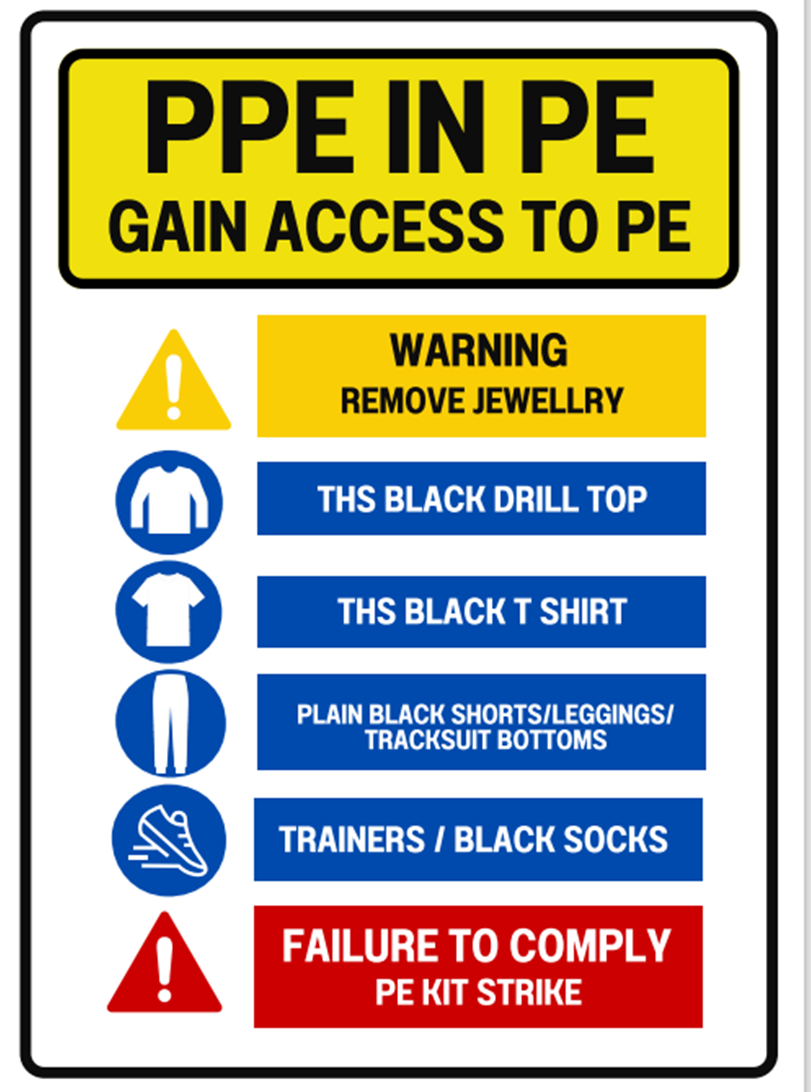
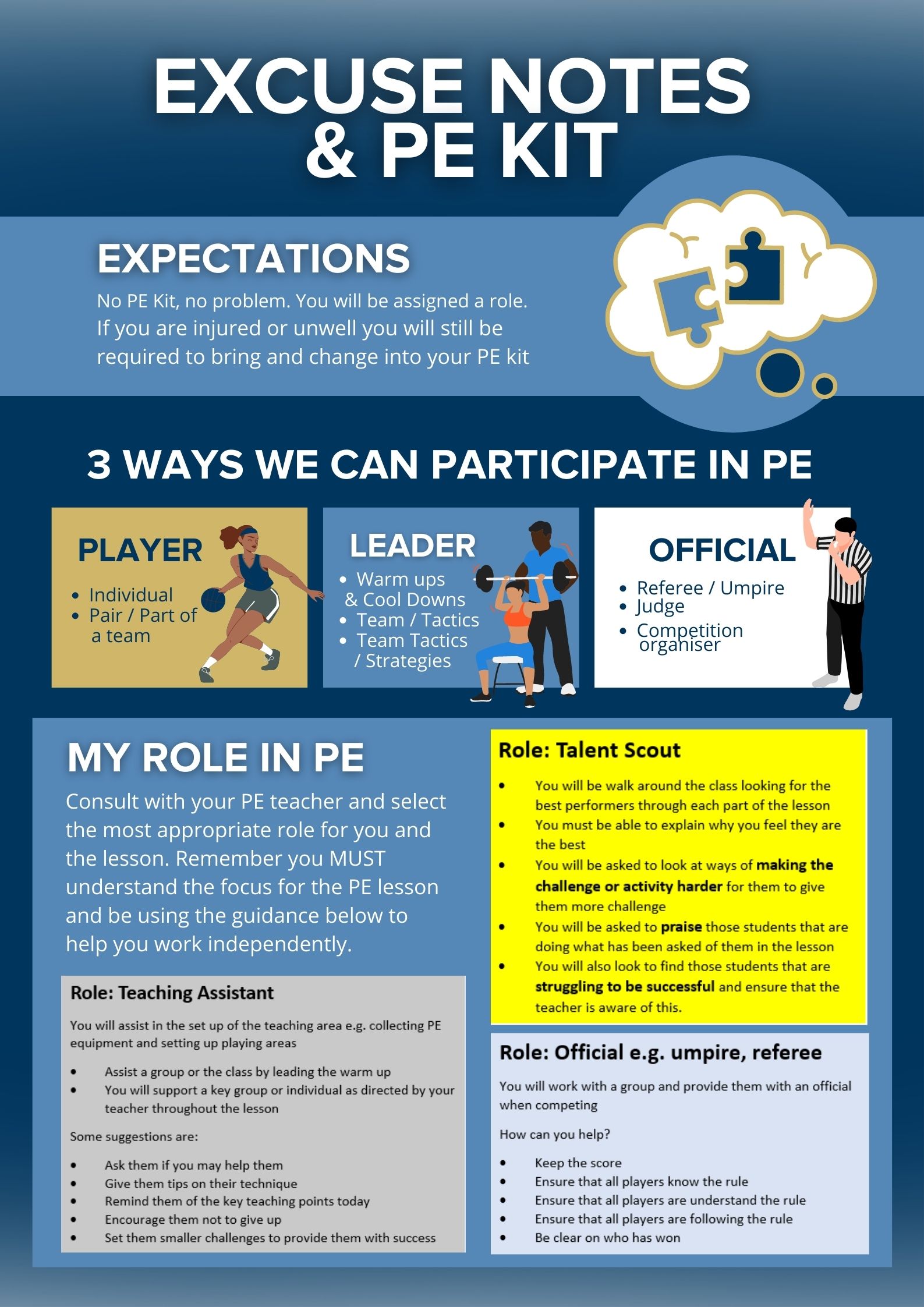
What if you forget your P.E. Kit?